
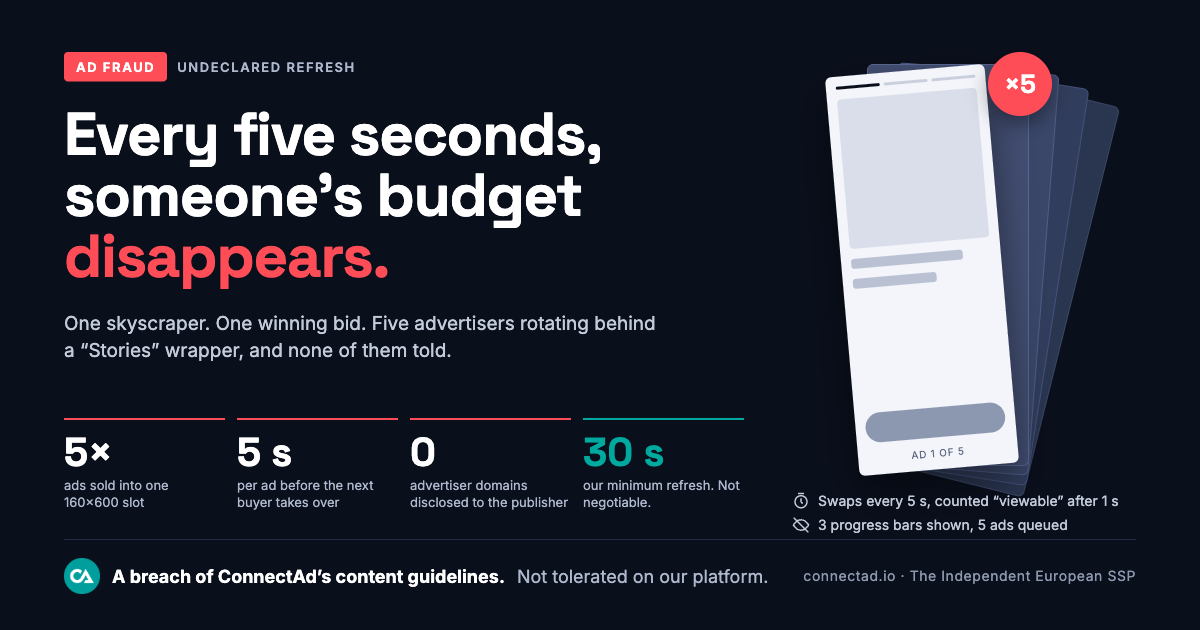
A colleague of ours hit “record” on a publisher page recently and caught something that shouldn’t exist in programmatic advertising: one skyscraper slot, one winning bid, and five different advertisers taking turns in it every five seconds. Nobody on the buy side had agreed to that. Here is what we found, why we call it fraud, and why we don’t work with anyone who sells inventory this way.
What we saw
The page was a large European news site in the automotive vertical. We are directly integrated with this publisher, so we look at their pages regularly. In the left-hand skyscraper, a 160×600 slot, something looked off. The ad changed. Then it changed again. A financial trading broker was replaced by a blank dark slide, which was replaced by a hotel chain’s Black Friday promotion, and so on, on a steady beat of about five seconds.
Across the top of the slot ran three thin progress bars, the kind you know from Instagram or TikTok Stories. It looks like a modern, swipeable carousel format, and that is presumably the idea. A genuine carousel ad is one advertiser telling one story across several cards. This one was several unrelated advertisers, bought by different buyers through different SSPs, rotating through a slot each of them believed they had bought outright.
What’s under the hood
The screen recording shows the symptom. The ad markup in the bid response shows the mechanics. The slot wasn’t served by the publisher’s own ad server. It was won in the publisher’s Prebid auction by a third-party yield intermediary, and what that intermediary returned was not a creative. It was a script that initialises a proprietary “stories” format, plus a configuration that tells the script what to play:
- Five creatives in one bid response. The configuration holds an array of five separately cached ads, each with its own cache ID on the intermediary’s Prebid Server.
- Multiple SSP paths, with the identifiers hidden. Each ad URL carries a parameter naming the SSP it came from, base64-encoded. Decoded, it points to two different, well-known SSPs. Encoding doesn’t make anything secure. It just makes things harder to read at a glance.
- A five-second timer. Each slide runs for 5,000 ms, including a 1,000 ms transition animation.
- Three progress bars for five ads. The format caps the visible indicators at three, so the user (and anyone checking the page) sees fewer slides than are actually queued.
- Preloading. Every slide after the first is fetched and rendered 1.5 seconds before it rotates in, so its impression can be counted at or before the moment it becomes visible.
- Nothing for the publisher to check. The advertiser domain list sent back to the publisher’s wrapper is empty, and the “creative ID” is simply the name of the placement. The publisher’s ad server and brand-safety rules have nothing to work with.
- Who wins? Only the intermediary in the middle. It wins one 160×600 slot in the publisher’s auction, pays for one impression, and sells that same slot up to five times on the other side. The difference stays with them. Everyone else in the chain pays for it.
- The advertisers and their DSPs. They pay for attention they don’t get. Viewability looks fine; click-through, attention and conversions don’t. Their optimisation algorithms are trained on misleading data.
- The SSPs in the chain. Their demand is being resold into a setup their own policies don’t allow, most likely without their knowledge. When buyers notice, it is the SSP’s path to that domain that gets blamed and cut.
- The publisher. In the short term, the auction shows a slot clearing at an attractive price. But a bid that can be priced against several impressions competes against honest bidders pricing exactly one, and that is a race the honest bidders lose. In the longer term, when buy-side SPO teams find undeclared five-second refresh on a domain, they don’t just block the intermediary. They throttle the whole domain, including every clean path on the page.
- Everybody else. Programmatic already has a trust problem. Every trick like this makes it harder for honest supply to get paid what it is worth.
- Watch your own pages. Literally. Leave a page open for 30 seconds and see whether a standard display slot changes advertiser. Screen recordings are cheap.
- Inspect winning bids. In Prebid, look for responses with an empty advertiser domain list, creative IDs that just repeat the placement name, or markup that loads a script rather than a creative.
- Ask your intermediaries directly. “Do you refresh, how often, and is it declared in the bid request?” A partner with nothing to hide answers that in one line.
- For buyers: look for domains and placements where viewability is high but time-in-view, attention and post-click metrics are consistently poor. That gap is often the fingerprint.
- We choose our supply partners carefully. We work one-hop: with publishers directly, or with intermediaries who work directly with the publisher. Every format and every refresh behaviour has to be transparent to us and to our buyers.
- We walk away, even after signing. This month we stopped an integration with a partner whose contract was already signed. Every supply partner signs our content guidelines as part of the contract, and a minimum refresh interval of 30 seconds is one of them. It is our standard, and we don’t negotiate on it. Before onboarding, we check every new partner carefully. In this case, the check showed creatives refreshing every 10 to 15 seconds and misrepresented ad sizes: a clear violation of the guidelines the partner had just signed. We flagged it and got no answer, so we stepped back from the partnership. The revenue would have been real. So would the damage to our buyers’ trust.
- We protect both sides of the auction. Our demand partners rely on us to deliver clean, efficient supply paths. Our publishers rely on us to protect the value of their inventory. Undeclared refresh betrays both, so it has no place on our platform.
From the publisher’s side, it looks like one decent bid for one skyscraper. From the buyers’ side, it looks like five ordinary 160×600 impressions. In reality, it is both, and neither side knows about the other.
Why this is fraud, not a “format”
Ad refresh is not illegal and not inherently evil. Done properly, it is declared to buyers in the bid request (OpenRTB 2.6 even has a dedicated object for it), it is spaced out sensibly, and buyers can decide whether they want to pay for refreshed impressions. Most SSP and buyer policies we know treat anything faster than around 30 seconds as off-limits.
What we recorded is the opposite on every count:
|
What the buyer thought it bought |
What the buyer actually got |
|
One standard 160×600 display impression |
One slide in a five-slide rotation in the same slot |
|
An ad that stays on screen for as long as the user reads the page |
Roughly four seconds before the next advertiser takes over |
|
A slot it could assess, block or exclude on brand-safety grounds |
A creative ID that only names the placement, and an empty advertiser domain list |
|
A clean, declared supply path |
Undeclared refresh, with the SSP identifiers base64-encoded in the ad markup |
The five-second rhythm is not an accident either. The MRC standard for a viewable display impression is at least 50% of the ad’s pixels on screen for at least one continuous second. Four seconds clears that comfortably. So every buyer in the rotation gets a report that says “viewable”, while in reality its ad was on screen for about as long as it takes to read this sentence before it was wiped and replaced by someone else.
We’ll say it plainly. If you sell an impression to a buyer as one thing, deliver something materially different, and engineer the setup so that neither the buyer nor the publisher can see the difference, that is not innovation. It is fraud against the buyer, packaged in a nice user interface.
Who wins, and who gets hurt
We are fairly confident the publisher in question doesn’t know about it. The format sits inside a bid response from a party they let into their auction. That is exactly the problem: the people paying the price are the people who can’t see it.
How to spot it
If you run a site or buy media, a few minutes of checking goes a long way:
Why ConnectAd ticks differently
To be clear: the company behind this format is not a ConnectAd partner. We spotted it because we work directly with the publisher and look at the pages we monetise, not just the reports. And we are publishing this because staying quiet is how practices like this become “industry standard”.
As a fully independent European SSP, we don’t have investors pushing us to grow at any price. That gives us the luxury of saying no, and we use it:
Our campaign line is “Maximum Impact. Minimum Waste.” Five ads squeezed into one slot every five seconds is the exact opposite: minimum impact, maximum waste, and someone else’s budget paying for it.
If you have seen something similar on your pages or in your campaigns, talk to us. We’re happy to take a look, and we won’t try to sell you a carousel.